Replacing Carpeted Stairs With Stained Treads and White Risers
Bare, stained treads with painted risers are a quick way to make a staircase look finished, but there are a few choices to make before the carpet comes up.
October 27, 2026 · 4 min read
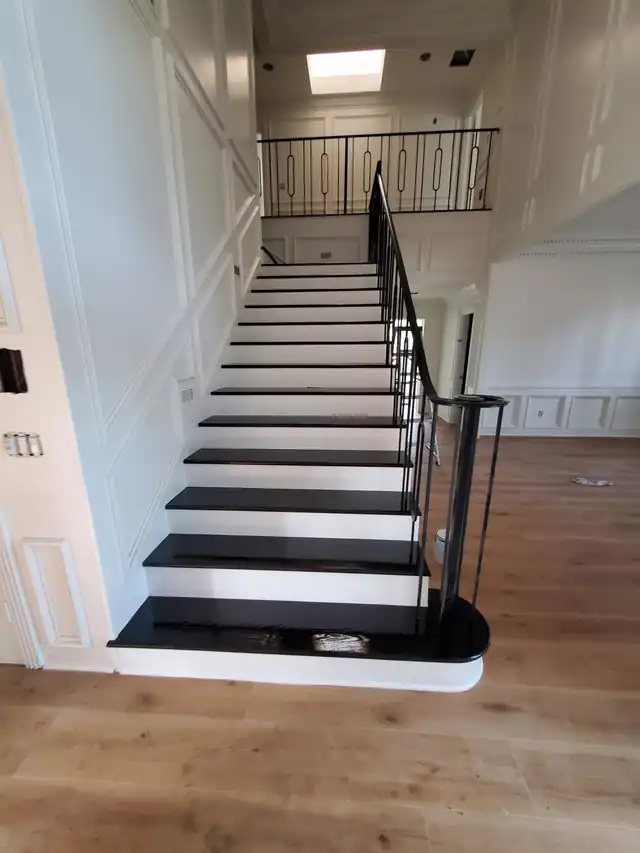
Carpet on stairs wears in a predictable pattern. The edge of every step gets flattened and gray, the sides go dingy, and the whole staircase starts to look older than the rest of the house. Many Dallas and Carrollton homeowners decide to pull it up and replace it with real treads and painted risers. The result is a stair that is easier to clean and a lot easier to look at.
It is a bigger decision than it sounds, though. Here is what to think through before the carpet comes up.
Treads and risers, in plain terms
The tread is the part you step on. The riser is the vertical face between one step and the next. On a carpeted stair, neither one was ever meant to be seen. Builders often use whatever material is cheapest and covers well, because the carpet hides it.
That matters because lifting the carpet is not always the end of the job. You might find stained plywood, uneven edges, nail holes, or glue lines. Sometimes the old treads can be refinished. More often, new treads are made and installed so the stair has real material and clean edges. A good contractor will tell you which one you are looking at after seeing it, not before.
Why stained treads and painted risers work
Wood gets stained, so the grain shows. Risers get painted, usually white, because paint is forgiving on a surface that gets scuffed by shoes and kids and vacuum cleaners. A painted riser can be touched up in minutes. A stained one needs more care.
There is a design reason too. Dark treads against bright risers create a clean line on each step, and the eye reads the stair as a series of crisp steps instead of a blurred slope. If you have wainscoting or white trim on the wall beside the stair, painted risers tie the whole run together. Our photo of a recent job, with dark treads, white risers and an iron rail, shows the idea.
Picking the stain
Stain looks different on every kind of wood, and it looks different again under your lighting. A color you love on a sample board can read redder or darker on the stair. Ask to see a sample on the same wood the treads will be made from, and look at it in the room, in the morning and at night, before you decide.
A few guidelines hold up in most houses:
- Match the undertone of nearby floors, even if you don't match the exact shade. Warm next to warm, cool next to cool.
- Go darker if you want drama and a modern feel. Go closer to your floors if you want the stair to disappear into the room.
- Think about the handrail and newel posts. The stain on the treads and the stain on the rail do not have to be identical, but they should look like they belong to the same family.
Grip, noise and wear
Bare wood is slicker than carpet. That is worth taking seriously, especially with kids, older relatives or dogs in the house. Ask about the finish that goes on top of the stain and how it affects traction. Some homeowners add a runner down the middle of the stair afterward, which keeps the stained edges visible and gives feet something to grab.
Bare treads also change how the stair sounds. Carpet muffles footsteps. Wood does not. A well-built stair is solid underfoot and quiet enough, and a poorly built one squeaks. If your carpeted stair already squeaks, say so at the estimate, since that problem is better solved while the treads are open and visible.
Protecting the house while it happens
Tread work is messy in the middle. There is cutting, sanding, staining and painting, and all of it is happening in the busiest corridor of the house. The question to ask is what the crew does at the end of each day. Lisa Webb said of Marlon and his team: "He was always prompt, polite and thorough. He and his team protected all my floors, cleaned up everything every day and made the process as hassle free as possible." That is a good benchmark.
Rail and posts come along for the ride
Once the treads look new, an old handrail and tired balusters stand out. Many homeowners decide to do it all at once: new treads and risers, iron balusters, and a freshly stained rail. It is easier to do the work in one visit than to disrupt the house twice. It also means every part of the stair is chosen to work with the others.
If you're not sure how far to go, that is a fine thing to discuss on the phone.
Start with a photo
Mac Stairs offers free estimates. Text a picture of your carpeted stair to (469) 727-3208, talk it through with Marlon, and you will get a quote after that. Include a shot of the side of the stair and the walls too, since those details help.
Mac Stairs, (469) 727-3208
Call (469) 727-3208More articles
Swapping Wood Spindles for Iron Balusters: What Changes
Iron balusters change how a staircase looks and feels, and the rail and posts around them usually come into the conversation too.
Choosing a Stair Railing Style: Bars, Cable, Scroll or Twist
Each railing style says something different about a house, and the right one depends on the room as much as on your taste.